OpsFlow AI
Purchase-order automation with structured extraction, deterministic validation, human approval, and resilient business-system integrations.
Explore the case study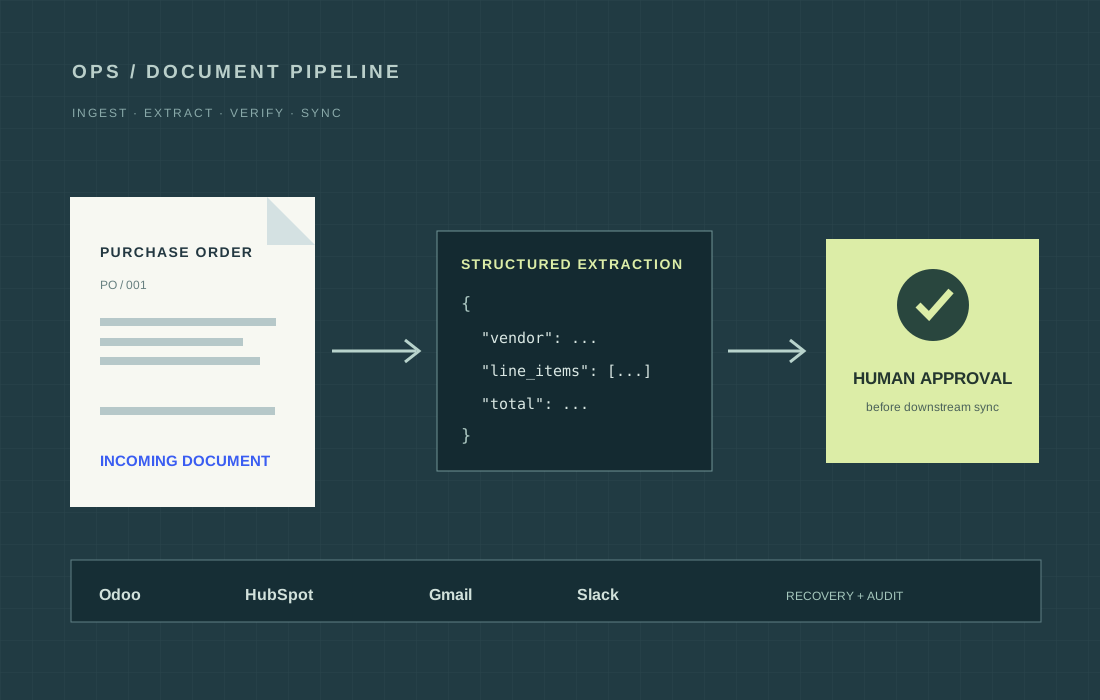
Original explanatory graphic, not a screenshot of the application.
Making document automation accountable.
Purchase-order workflows combine unstructured documents, business rules, approvals, and third-party systems. Extracting a value from a PDF is only one part of the task; the system also needs to validate that value, avoid duplicate actions, recover from failures, and make changes inspectable.
OpsFlow AI is my purchase-order automation project, built around document ingestion, structured LLM extraction, deterministic checks, human approval, and synchronization with operations systems.
Keep uncertain steps separate from irreversible actions.
The stack brings together Python, FastAPI, PostgreSQL, n8n, React and Docker. It integrates with Odoo, HubSpot, Gmail and Slack, using persistent state, idempotent synchronization, retries, recovery paths, and audit trails.
My emphasis was not simply getting the happy path to work. Integrations can timeout or replay requests; a reliable workflow needs to know whether an external action already happened, what remains pending, and when a person must approve it.
Validation beyond a demo.
Work on the project included evaluation of extraction correctness, reliability, latency, and token cost, as well as automated testing. Its portfolio value is the engineering of the workflow and its failure-handling boundaries.
Where judgment matters.
- LLM vs. rules: use an LLM to handle variable document structure, while enforcing deterministic checks where possible.
- Automation vs. oversight: include a human approval boundary before consequential downstream updates.
- Simple sync vs. recoverable sync: prioritize idempotency, persistence, retries, and auditability when communicating with external platforms.
This is an engineering case study, not a claim that every possible business workflow is supported out of the box.
Explore the work.
A specific repository and live demo URL can be added when confirmed. The GitHub link currently points to the verified profile address from the CV.