RuralStroke Triage
A multimodal smartphone screening-support research prototype that combines independent proxy signals using interpretable, missing-modality-aware late fusion.
Explore the case study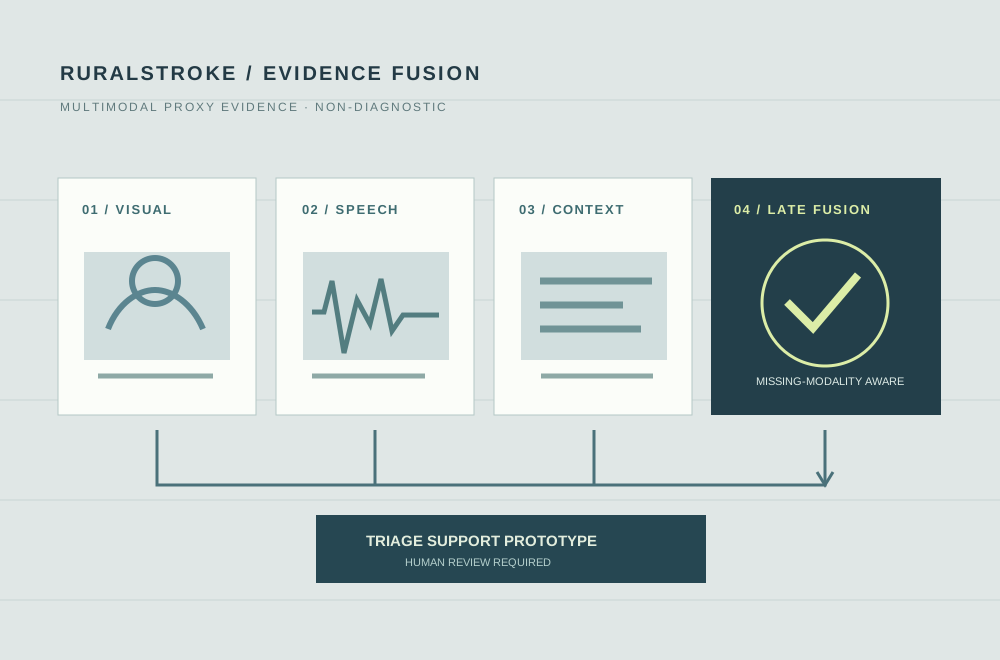
Original project artwork illustrating the research prototype’s independent evidence branches and late-fusion concept.
What if the evidence is incomplete?
Prehospital stroke screening in resource-constrained settings involves limited connectivity, noisy recordings, and missing information. A system cannot assume all evidence sources are available or that model outputs from unrelated datasets can be treated as a calibrated clinical probability.
RuralStroke-Triage is a non-diagnostic research prototype that integrates smartphone-compatible visual, speech, patient-context, and FAST/BE-FAST symptom evidence through interpretable late fusion and deterministic escalation logic.
Independent evidence branches, interpretable fusion.
The accepted manuscript describes a frozen MobileNetV2 image branch for facial asymmetry, a Random Forest over engineered dysarthric-speech features, a logistic-regression metadata model for contextual risk, and a deterministic symptom branch.
Independent branch scores are combined through manually specified late-fusion weights. Missing modalities are omitted and the remaining weights renormalized; acute FAST findings can trigger deterministic escalation. Outputs remain non-clinical evidence scores rather than jointly calibrated diagnosis probabilities.
Proxy-task performance, with explicit limits.
The reported held-out ROC-AUC results were 0.9809 for the visual branch, 0.9426 for the speech branch, and 0.8338 for the metadata branch. The work additionally passed 33/33 symptom scenarios and 276/276 deterministic fusion checks.
These results are not end-to-end clinical accuracy. The branches use independent proxy datasets with different labels, participants, and protocols. In particular, TORGO dysarthria is not an acute-stroke-specific label.
Designing for what the data can support.
- Late fusion over learned joint fusion: linked multimodal patient data was unavailable, so jointly training fusion would have introduced unsupported relationships.
- Transparent escalation: deterministic FAST rules make high-priority evidence auditable rather than leaving it entirely to a learned threshold.
- Separate branch metrics: performance is reported for each modality rather than misrepresented as end-to-end diagnostic accuracy.
The research was authored and presented at MIUCC 2026. Its status is: Accepted and presented — IEEE Xplore publication forthcoming.
Publication details.
The manuscript PDF is not included in this public release while the appropriate author-accepted version and hosting rights are confirmed. Bibliographic status: Accepted and presented — IEEE Xplore publication forthcoming. No DOI is claimed.